
TL;DR:
Modern businesses can’t grow, pivot, or innovate as quickly as their data architecture allows. Yet most enterprises still manage customer, product, and vendor data in disconnected silos, leading to conflicting insights, compliance risks, and unreliable AI. Multi-domain orchestration bridges these gaps by unifying relationships, enforcing governance, and making trusted data instantly available across all systems and AI workloads.
Why Multi-Domain Orchestration Matters
Your organization’s competitive edge depends on how effectively it manages its most critical data. Customer information, product catalogs, vendor hierarchies, contracts, and campaign signals all form part of a larger data ecosystem. However, when each domain operates independently, spread across dozens of cloud platforms and business systems, context is lost, duplication increases, and decision-making slows.
Traditional MDM was designed to address this issue, but only partially. Early systems managed a single domain, typically “customer,” while leaving everything else to chance. In today’s interconnected world, that model breaks down. A unified customer profile is of little value if it isn’t connected to the correct product, billing record, or support ticket.
Multi-domain orchestration extends MDM by synchronizing and governing all foundational entities—customers, products, vendors, employees, locations, and contracts—within a single semantic framework. Instead of treating data as isolated records, it preserves the relationships between them, creating a living, contextual fabric that fuels analytics, automation, and AI.
The Modern Data Challenge
Over the past decade, enterprise data complexity has exploded. Most organizations now run dozens of mission-critical systems: Salesforce for sales, NetSuite for finance, Marketo for marketing, ServiceNow for operations, and Snowflake for analytics. Each system defines its own version of “truth.” The result is a tangled web of integrations, redundant data, and inconsistent hierarchies.
Point-to-point APIs and iPaaS connectors can shuttle data between systems, but they don’t clean, standardize, or govern it. They simply move inconsistency faster. Without orchestration, every new sync or integration introduces fresh errors and more technical debt.
Meanwhile, the adoption of AI raises the stakes. Generative and predictive models depend on clean, contextualized inputs. If your product data isn’t tied correctly to customer accounts, or if billing relationships are out of sync, your AI copilots will make decisions based on fiction, not fact.
Industry trends indicate a future where modern MDM platforms will increasingly rely on AI to automatically detect, predict, and resolve data issues, thereby dramatically reducing manual effort. Generative AI is also expected to amplify the impact of governance and MDM initiatives, accelerating time to value across the business. However, these advancements can only be realized with a real-time, governed, multi-domain data foundation underlying them.
From Single Domain to Unified Orchestration
Where legacy MDM tools rely on rigid schemas and long implementation cycles, multi-domain orchestration is modular, composable, and cloud-native. It doesn’t just manage master data—it orchestrates how it moves, transforms, and maintains integrity across domains.
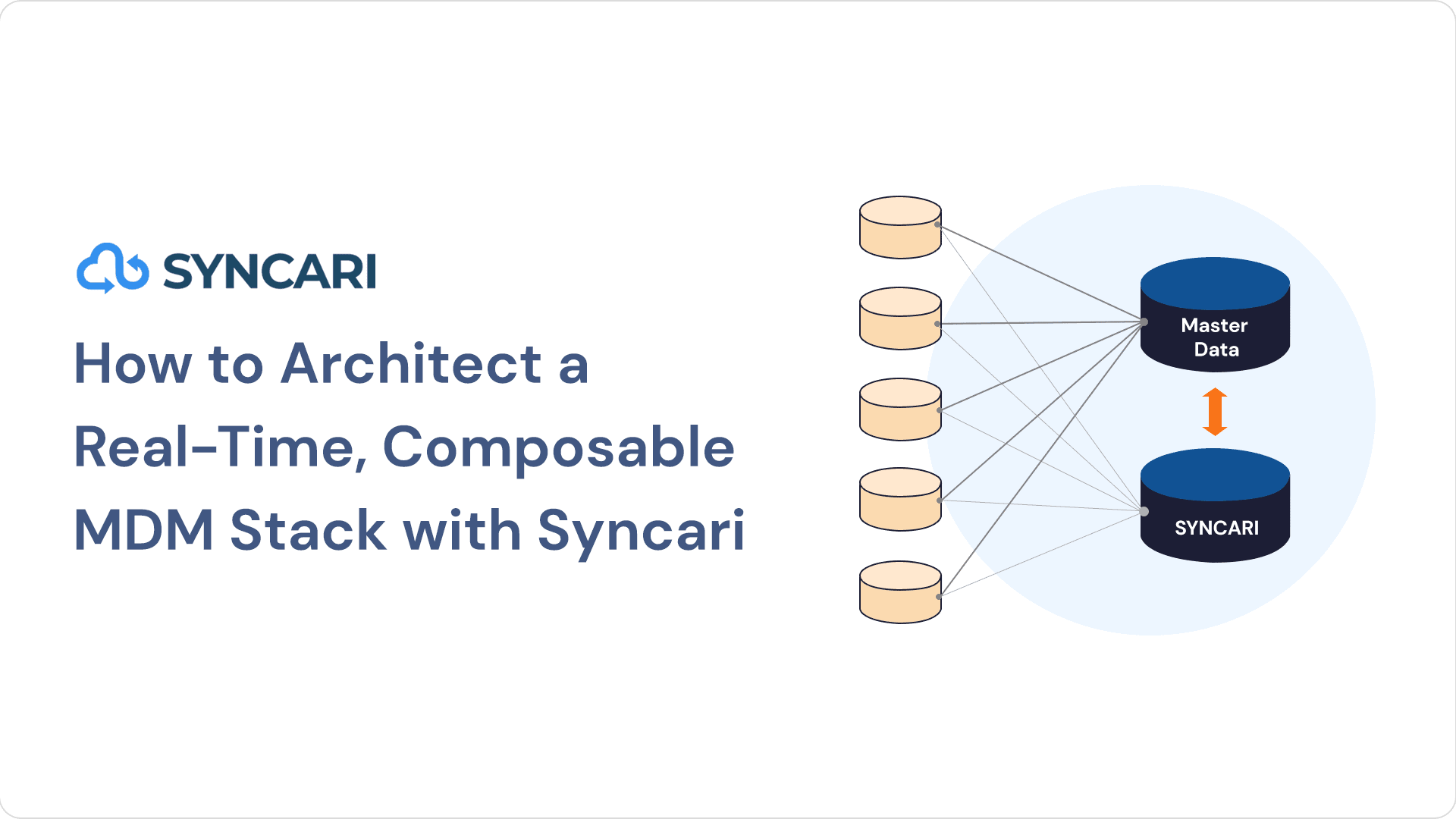
Syncari’s approach is built around a central semantic model that understands relationships between entities. Customers link to products, products link to vendors, and accounts link to billing and contracts—all synchronized in real time across connected systems. Each update is validated, versioned, and propagated bi-directionally, ensuring that every domain reflects the same source of truth.
Because orchestration occurs at the semantic level, governance is built in. Every change is policy-checked, lineage-tracked, and logged for auditability. Instead of adding a separate compliance tool, Syncari enforces governance as data moves—making compliance continuous, not periodic.
Inside Syncari’s Agentic MDM™ Platform
Syncari’s Agentic MDM™ unites MDM, integration, and automation within a single platform. It brings together five core capabilities that redefine what multi-domain orchestration can do:
- Unified, contextual data models
Syncari maintains a centralized model tailored to each enterprise, ensuring that product, customer, and account data remain synchronized and semantically linked. Systems no longer compete for ownership of data—they collaborate through a common, governed layer. - Embedded governance and policy enforcement
Every transaction is validated against predefined quality and compliance rules. Whether a change originates in Salesforce or Snowflake, Syncari ensures it aligns with corporate data policies and lineage expectations. - Real-time, bi-directional synchronization
Data moves continuously, not in nightly batches. Updates in one system instantly propagate across others, providing teams with the most current and trusted information wherever they work. - AI-ready structured context
Syncari’s MCP Server connects governed data directly to large language models such as Claude and, soon, others. This structured context enables natural-language queries and AI actions based on live, trustworthy data—grounding agentic intelligence in reality. - Modular deployment and composability
Unlike traditional MDM systems that require a rip-and-replace approach, Syncari can be implemented incrementally. Enterprises can orchestrate one domain, prove value, and expand—reducing time to ROI while minimizing risk.
Overcoming the Pitfalls of Legacy MDM
Traditional MDM platforms often fall short because they were built for a different era—on-premises, rigidly schema-based, and heavily reliant on professional services. Implementations drag on for months or even years, costs escalate quickly, and integration with operational systems remains limited. Instead of solving data problems, they frequently create yet another silo.
Multi-domain orchestration turns that model on its head. Syncari deploys in weeks, integrates seamlessly with existing systems, and scales elastically in the cloud. It evolves with your business—supporting new domains, shifting operating models, and emerging AI needs—without requiring re-architecture or downtime.
As enterprises seek to simplify and unify their data governance strategies, the need for a single platform that encompasses analytics, privacy, and operational data becomes increasingly apparent. Multi-domain orchestration is designed for this shift: a unified approach to establishing and maintaining data trust across the organization.
With Syncari, organizations can enable true federated governance—a framework where business and IT collaborate through shared policies and transparent oversight, while each domain retains autonomy. Departments can innovate with confidence, knowing their data stays synchronized, validated, compliant, and ready for action.
Powering the Next Generation of Intelligent Enterprises
The future of AI and analytics depends on context. Without unified, multi-domain data, even the most advanced models will misinterpret signals and amplify errors. Multi-domain orchestration transforms that foundation—connecting systems, maintaining relationships, and ensuring that every AI agent, dashboard, or workflow operates on truth, not assumption.
Syncari’s Agentic MDM™ embodies that future. It replaces manual reconciliation with autonomous synchronization, merges integration and governance into a single intelligent layer, and prepares enterprises for the decade ahead, driven by AI.
Ready to unify your data fabric and future-proof your enterprise data architecture? Get a personalized demo today and see how Syncari’s multi-domain orchestration can help you build the contextual, AI-ready foundation your enterprise deserves.